


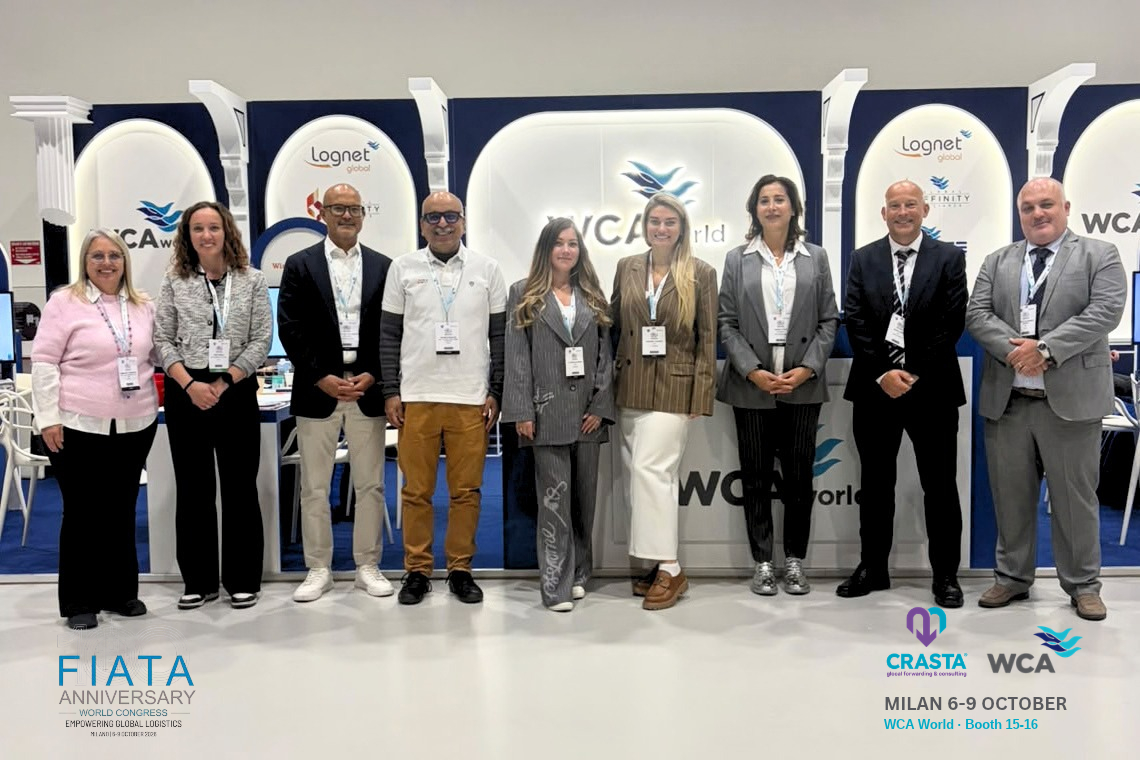
From 6 to 9 October, Enrico Francesco Crasta was in Milan, at the WCAworld booth, for the FIATA World Congress 2026.
This was not a matter of representation. The work we do every day — getting a customer’s cargo to the other side of the world, and bringing cargo into Italy on behalf of operators who have no one here — rests on a network of people. That network is built over years of operations handled together, and it is held together in the few days when all those people are in the same place.
Why we were in Milan
Most of the enquiries that reach Crasta come from a foreign correspondent with cargo bound for Italy, or from a customer who needs to ship to a country where we have someone we trust.
That “someone we trust” is not an address on a list. It is a person we have met, with whom we have handled a difficult file, and whose behaviour we know when things get complicated. You learn that only by working with them — and, before that, by meeting them.
A world congress is where those people meet. That this year it was held in Italy changed the nature of the trip.
The choice was not an organisational detail: FIATA decided to celebrate its hundred years in Italy at a moment when the Mediterranean has become, once again, the stretch of sea where routes are decided — and Italian ports are no longer one destination among many, but one of Europe’s gateways.
And Italy, for anyone shipping into it, is precisely the difficult part. Customs procedures with their own specificities, excise duties, selective controls, requests for additional documentation that have to be answered quickly. And we have been working on it for seventy years.
A hundred years of FIATA
FIATA was founded in 1926. Over the following century it built the standards, the documents and the shared language that make international transport work: the tools that allow an operator in Naples and one in Ho Chi Minh City to understand each other about what is happening to the cargo, without ever having spoken before.
The centenary edition was held in Milan, hosted by Fedespedi, with more than a thousand delegates from every continent and a motto — Empowering Global Logistics — that says a good deal about what was actually discussed: not celebration, but how freight moves now.
As FIATA President Prof Dr Thomas Sim put it, this marks “a century of freight forwarders coming together, building standards, forging partnerships”. It is a dry definition, and it is exactly the job.
The WCAworld booth, and what standing there means
WCAworld was Platinum Partner of the congress, and we were at its booth as the network’s Italian member.
It is worth explaining what that means, because it is the part a customer rarely sees. A network like WCA connects independent freight forwarders from all over the world: companies like ours, which do not belong to a multinational and remain in charge of their own decisions, but which alone could not cover every route. Within the network, each member is the point of reference for its own territory for all the others.
For us this means two things, in opposite directions.
When one of our customers ships to a distant country, at the other end there is no supplier found for the occasion: there is a member of the network, with verified requirements and a reputation to defend in front of every other member.
And when a foreign operator needs to bring cargo into Italy, the network’s Italian desk is us. That means direct customs and fiscal representation, knowledge of the relevant customs offices, experience with cargo that is not straightforward — chemicals and energy products, excise goods, out-of-gauge shipments — and someone who can turn up in person when that is what it takes.
Three themes from the congress
Routes are moving. Geopolitical uncertainty is redrawing established corridors. This is no longer an exceptional phase to get through: it is the condition under which planning now happens. Shippers need alternatives ready before they are needed.
Documents are going digital. Traceability, electronic documents, interoperability between systems: ground FIATA has worked for decades, and where the difference between one shared standard and fifty proprietary ones is measured in days of delay.
Sustainability has become a cost. This is the sharpest shift: from a commitment on paper to a line in the quotation. EU ETS first, UK ETS for maritime from July 2026, CBAM. These are no longer statements, they are figures that enter the price and have to be explained to the customer before departure.
What it means for shipping to and from Italy
A congress does not produce regulation, but it shows early where things are heading. Three consequences are already readable today.
Environmental costs must be quoted, not discovered afterwards: a quotation that leaves them out is no longer complete.
Documentation tolerates less approximation: with more automated screening, a wrong classification no longer produces a phone call, it produces a hold.
The point of entry is no longer automatic: with routes shifting, the right port depends on the origin of the goods, the type of cargo, real transit times and the specific procedures of each customs office.
Of those hundred years of FIATA, Crasta has been through more than seventy. We will keep showing up where our network meets, because that is where you build what actually matters later: someone to call, when the cargo is seven thousand kilometres away and something goes wrong.
If you ship to or from Italy and are looking for a direct partner on the ground, get in touch.


